Sic Semper Tyrannis
Meet Virginia

I watched the results come in last night, the way you watch a heartbeat monitor after surgery. Nervous. Anxious. Hitting refresh on my phone screen every two seconds. Virginia was voting on the redistricting amendment, and I couldn’t look away.
Virginia voted yes.
I wasn’t there to cast my ballot—I haven’t lived in the Commonwealth for almost 15 years—but I felt a huge sense of pride anyway.
That’s the thing about Virginia. You can leave it, but it never leaves you.
I am a displaced daughter of the Commonwealth. I went out into the world, made my life elsewhere, but I know my roots. Virginia has always been where history happens first. Where the arguments that shape the nation get started before they spread everywhere else. Where we demand a voice in how we’re governed and refuse to shut up until we get one.
Right now, that instinct is on full display. The 9th Congressional District race isn’t just a local election. It’s a test of the American democratic engine—and Virginia is passing in flying shades of blue.
Sic Semper Tyrannis means “thus always to tyrants.” It’s a warning and a promise. This is what happens to tyrants. They fall. Every time.
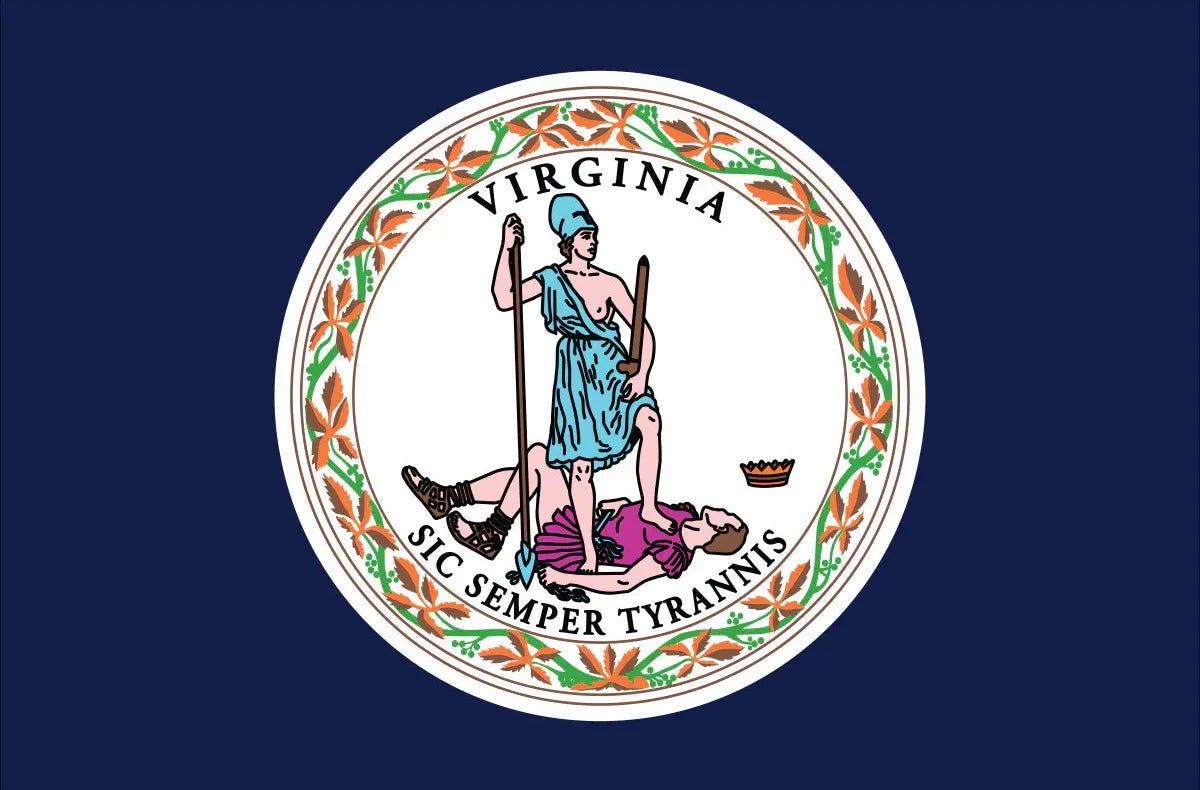
Look at the flag. That’s Virtus, the Roman personification of moral fortitude and virtue. She’s an ideal. Righteousness. Courage. The willingness to stand up and fight when fighting is necessary.
There she is: spear down (peace preferred), sword sheathed (but ready), foot on the chest of a fallen tyrant. The tyrant holds a broken chain and a scourge, the tools of enslavement. His crown has toppled beside him.
The original design was probably drawn by George Wythe in 1776, the same year we declared independence. This wasn’t subtle. The tyrant under Virtus’ foot was Great Britain. The message was clear: we will not be ruled.
This is who we are. It’s who we’ve always been.
I’ve always said one thing about Virginia: throw a rock and you’ll hit something important. A battlefield from the Revolutionary War, War of 1812, Civil War—pick one. Or you’ll hit a history first. First Landing. Jamestown. Williamsburg. You can’t separate American history from Virginia history. They’re forever intertwined. One and the same.
In 1788, Virginia ratified the United States Constitution by ten votes. Eighty-nine to seventy-nine. Ten votes. Virginia almost walked away from the whole thing. Patrick Henry and George Mason fought it because the document lacked a bill of rights. Mason had already written the Virginia Declaration of Rights in 1776—the first bill of rights in any American constitution. He had already invented the concept at home. He refused to sign onto a national document that lacked it.
Virginia ratified conditionally. We’re in, but only if you fix this. The United States Bill of Rights followed in 1791. We got what we demanded.
Virginia kept writing American history, getting edited, and writing it again. The Declaration of Independence—written by Thomas Jefferson. The United States Constitution—James Madison was the architect. The United States Bill of Rights—modeled on George Mason’s Virginia Declaration of Rights.
So when Virginia holds a redistricting process that actually involves the voters? When the people get a say instead of some Austin backroom deal? That’s four hundred years of demanding a voice in how we’re governed.
To be clear — gerrymandering and redistricting is an arms race but it’s important to remember who started it.
Let’s get the timeline straight, because the “both sides” crowd loves to muddy this up.
In summer 2025, Trump pressured Texas Republicans to redraw their congressional maps mid-decade to lock in more Republican seats. Texas Democrats fled the state to deny a quorum, just like they did in 2003, but ultimately failed. By August, Abbott had signed it into law. No voter input. Not on a ballot. Just a power grab.
The map was designed to give Republicans five additional seats. A federal court later ruled it was an unconstitutional racial gerrymander. To the shock of no one, the Supreme Court granted a stay. The map stands for now.
California warned Texas. In July 2025, as Texas Republicans pushed their gerrymander through the legislature, Governor Newsom made it clear: if you do this, we will respond in kind. Texas called the bluff.
California doesn’t bluff.
Governor Newsom and Democratic leaders pushed to redraw California’s congressional districts to offset the blatant Texas power grab. The critical difference: California has an independent redistricting commission. They couldn’t just draw a new map and push it through to law. They had to pass a constitutional amendment and put it to the voters. On November 4, 2025, California voters overwhelmingly approved the new map by a 29-point margin.
Missouri and North Carolina followed Texas, GOP legislatures passing new maps without voter approval. Cue the eyeroll.
Virginia jumped into the ring. In October 2025, Virginia Democratic leaders announced they were considering mid-decade redistricting in retaliation for North Carolina’s new map. Like California, Virginia has a commission. They proposed a constitutional amendment, meaning voters have to approve it.
On April 21, 2026, the people said YES.
Virginia voters went to the polls for a special election and approved the amendment. The new map could shift as many as four House seats. Governor Spanberger emphasized it was a “temporary measure” to counter Trump’s push for gerrymandering in other states. As written, the amendment expires in 2030, returning redistricting to the bipartisan commission.
See the pattern?
In Texas, Missouri, and North Carolina, lawmakers just did it. No voter input. Nothing on a ballot. Trump threatened to primary any Republican who resisted so they rolled over.
In California and Virginia, voters got the final say. California put it on the ballot. Virginia put it on the ballot. The people spoke.
One side draws maps in backrooms. The other side lets the people decide.
That’s not “both sides.” That’s one party respecting the process and the other subverting it.
Virginia picked Virtus for its flag, the ideal that ordinary people can stand up to kings. She’s winning. The tyrant is on the ground. His crown is in the dirt. His chains are broken.
Stamped on our seal in 1776, before we were a nation.
Sic Semper Tyrannis
On April 21, 2026, Virginia proved it again.
Update: 5:44 pm EST, April 22, 2026, a Republican appointed judge in Virginia has ruled the redistricting unconstitutional. This places the results of the election on hold. The voters decided but this is going to be a fight in the courts. I’ll keep you posted.
Thank you for this history reminder. We the people…..